Showing posts with label Bilingualism. Show all posts

01 November 2012

Let the Negativity Begin!

It didn’t take long for the Moaning Minnies to pop up and say the Australia in the Asian Century White Paper will never work.
Opinions in the media are easy to find.
Here is a sample of  a collection of very dodgy language myths and falsehoods;
“..anyone over the age of 12, the intonations, grammar, sentence structures and colloquialisms of another language seem like an Everest to master.”
Many students really enjoy the challenge of learning another language. Learning a foreign language allows the development of higher order thinking skills.
Bilingualism and second language learning can be acquired at anytime in life. It has much more to do with motivation and perseverance rather than when you start learning.
Have a listen to this.  Your Fabulous Bilingual Brain! Radio National – All in the mind
“In the past, for English speakers, it's been relatively easy to learn a foreign language.”
There is no ‘easy’ way to learn a foreign language.  Otherwise those “Learn Language X in 10 minutes a day” books and audio would really work. Learning any foreign language has ‘swings and roundabouts’ in the cycle of learning.

“Business people who travel from Shanghai to Singapore, or from Tokyo to Taipei will tell you time and again that unless you're on the pointy end of trade, people in Asia won't want you to practise your dodgy local language skills on them: they want to practise their YouTube versions of English on you.”
So you are saying our “Business People” only speak dodgy foreign languages? I am sure they would be delighted to hear this.  Perhaps that is why a White Paper has been published so that we can educate our future “Business People” so that they can learn better than dodgy language skills.
Also explain why is it ok for an Asian business person to practice their English (apparently they only use YouTube to learn English) on our Business people? Yet we can not practice our foreign language skills with them.
“But Chinese and Japanese both use different alphabets and very subtle juxtaposition of symbols to create nuances in their written languages.”
  1. Chinese and Japanese both have a non-alphabetic scripts
  2. Chinese word order is quite strict (there is less flexibility with word order compared to English).
  3. Nuances in written language is not peculiar to Chinese and Japanese.  All languages have this.
“This subtlety also extends to the tonal nature of their pronunciation and vocabulary, where it's much easier to make mistakes than in the European languages.”
  • Japanese is not a tonal language.School
  • Hindi is not a tonal language.School
  • Indonesian is not a tonal language.School
  • Yes Chinese is a tonal language.Light bulb
So three out of four of the languages in the White Paper are not tonal languages.
“That is why high school students drop out of Asian languages - if offered - at a high rate. They're just too hard. ”
Too hard for you perhaps!
However, in my humble opinion the drop out rate has more to do with how the language is delivered or presented to out Ozzie students.  “If you build it they will come”, give our students an attractive, exciting and rich learning experiences in the language classroom and they succeed in language learning.

So now that I have dispelled all the farcical nonsense from this (in my humble opinion) very poorly written article. Which is full of broad language learning  generalisations and lacking in factual details.
Lost in translation - why Gillard's plan won't work
It would be nice if there was not such bias against a new idea (learn an Asian language in school) and that at least we could try it. Better than clinging to (and publishing) old out-dated myths about language learning.

I now have a crusade to go and find more of these badly written and false pieces of writing about LOTE and set the Ozzie world right.

28 October 2012

Killer Fact 洋鬼子 yáng guǐzi

Killer Fact  洋鬼子 yáng guǐzi


Here is something interesting a pejorative term for foreigners 洋鬼子 yáng guǐzi  literal translation is a 'Foreign Devil'. 

Now where does this all come from?  I am glad you asked. Historically (not now of course) the Chinese viewed people beyond their borders as barbarians.

Two derogatory terms were used;

In the southern parts of China, the term Gweilo or Gwai Lo 鬼佬; Cantonese gwai2 lou2 was used.

In Northern parts of China, the term Western ocean ghost 西洋 鬼子 Xi Yang Guizi was used, Europe West of China.

Breaking it down;

The term gui ghost in guizi devils 鬼子 is an adjective that can be used to express hate and deprecation. The character gui alone can have negative connotations.


More information;

Westerners were called Yang Guizi 洋鬼子 during Boxer Rebellion 1898 - 1901.
Japanese military in the term devil soldiers Guizi Bing 鬼子兵 during the Second Sino-Japanese War 1937 - 1945.  The Korean military with the term Second Devil Er Guizi 二鬼子.

Guizi can be used to refer to either Japanese 日本鬼子; pinyin: rìběn guǐzi; literally "Japanese devil", or  東洋鬼子; pinyin: dōngyáng guǐzi; literally "east ocean devil".

Westerners  洋鬼子 yáng guǐzi; literally "Westernern devil, west ocean devil" or 西洋鬼子; pinyin: xiyáng guǐzi; literally "west ocean devil".


Now another word for foreigners in Mandarin Chinese is Laowai   老外 lǎowài literally "Old Outsider" (Alien is actually the best translation) is also a little bit controversial with some folk. Especially the expatriate community in China. Similarities in other lands include gringo  how some Americans view the Spanish/Brazilian Portuguese in their lands, the Japanese word gaijin,  Thailand has farang and Germans have Ausländer. By the way I have been a  gaijin, a farang and an  Ausländer and it didn't bother me.

你好。我是样鬼子。

25 October 2012

Australia in the Asian Century -White Paper release on 28 October 2012


Australia in the Asian Century

White Paper release on 28 October 2012
image
Much discussed since its inception the Australia in the Asian Century White Paper is to provide a direction for Oz to engage with Asia.  The rest of the world is doing this…we are discussing and thinking about it. I wonder what to expect. 
Is this long awaited White Paper the panacea or the Silver Bullet for a solution to our lack of engagement to our Asian neighbours?
Is it a case of ready, set, engage with Asia Now?
I fear that it is going to take a lot of re-education for many in Oz. 
Here is an example of some older outback Ozzies view our place in the world…

CWA keen to be part of outback royal visit

“…but a lot of the older ladies do look to the monarchy for leadership and for being part of our organisation.”
"Our motto that we say at each meeting is 'honour to God, loyalty to the throne, service to the country, through country women, for country women, by country women”.
God Bless you Country Women’s Association.


11 August 2012

I love a good Language Infographic

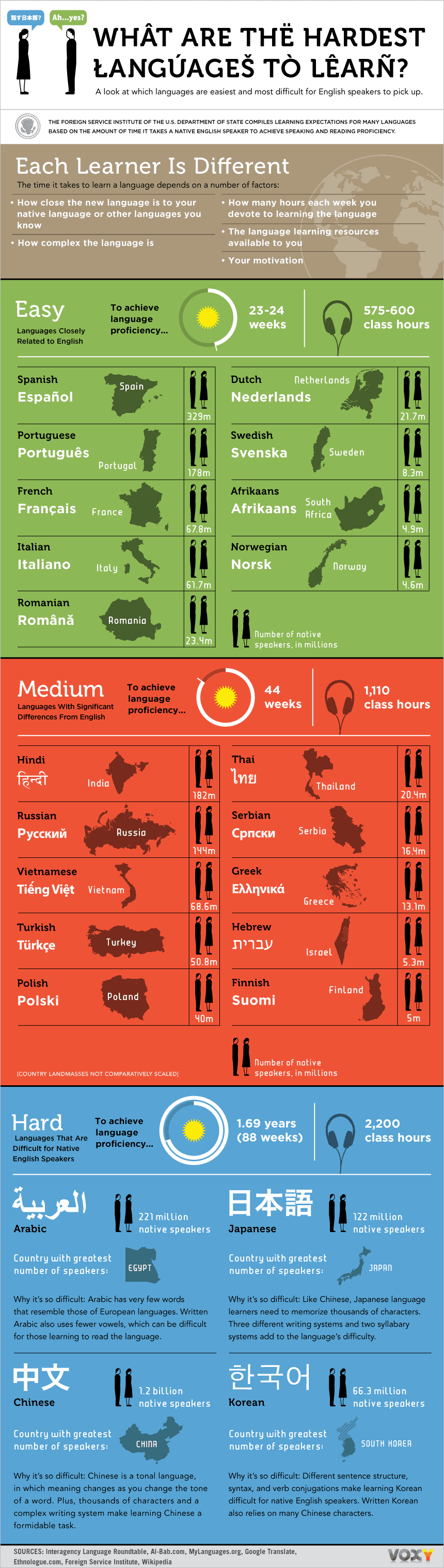
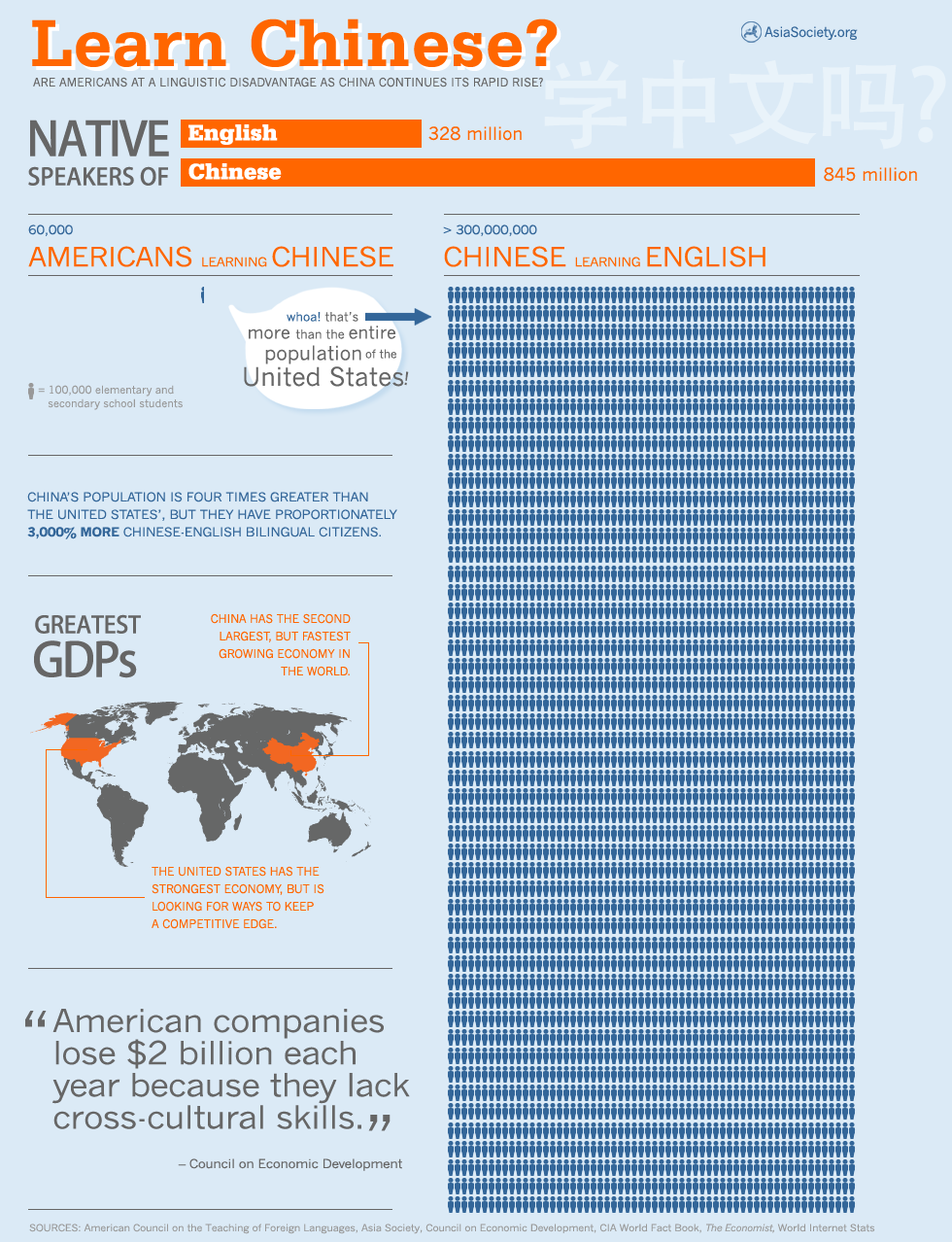
A collection of Language Infographics. I like to read these, though some are inaccurate. I suppose if you get some statistics and present them in a colourful and attractive way it makes and interesting read. Though I think you can emphasise and highlight some things with a clever graphic representation. Still I enjoy reading them.


America Meet China


Some of these I have found and blogged before...others I found on Pinterest (a pictorial aggregator / semi social networking site), for compiling some of the Language Infographics.  You may find the other things on the board interesting too.  You might find a Chinese Mandarin Learner board there too. 

30 July 2012

8 Useful Phrases for American Retailers

This is very clever.  I found it originally posted on Magnus and Mingxin's board on Pinterest.


It is the creation of Dim Sum Warriors who write a bilingual app. The aim of the app is to help English and Mandarin learners in a way that is innovative, effective and fun. Looks like an excellent idea. 


Read a Comic, Learn a Language


16 June 2012

Why You Should Learn Chinese


Dreaming in Chinese: Mandarin Lessons in Life, Love, and Language

A two year old article from Time, yet it is still relevant today. The article is a question and answer interview about learning Mandarin and China.  It is worth reading.

  One book I will be adding to my reading list.

Q&A: Author Deborah Fallows on Learning Mandarin

09 June 2012

Never too early to learn Chinese?


Meanwhile in Naselle, Washington...

"Instead of “Dick and Jane” and “See Spot Run,” the morning curriculum at Naselle for kindergartners next fall will be entirely in Mandarin Chinese ..."

"The district is considering implementation of dual-immersion education to kindergarten students whose parents choose to participate in the Mandarin Chinese program next year."

"If adopted by the school board, the program will be taught by a teacher from China and the students who voluntarily enroll will speak nothing but that language exclusively during their morning classes..."

I find "the sooner the better" trend being reported often across the globe. It is interesting that our opposition government in Oz has seized on this and made an election promise  Preschoolers to learn a second language .  While many places are implementing it is schools immediately.

In my humble opinion it is never too early or too late to learn Chinese Mandarin.

Never too early to learn Chinese?

07 May 2012

Why Languages Can Make Us Smarter, Safer, and Better Looking - Global Learning - Education Week


Some important issues are discussed in the Why Languages Can Make Us Smarter, Safer, and Better Looking  from Global Learning blog.

There are two basic arguments for second language learning;


One; learning a language is good for national security and economic competitiveness (this argument is a good one for politicians and business leaders)

"this can make our nation stronger"

Two; learning a language  is good for cognitive and cultural benefits (good for those in the arts and education business and parents)

"this can make my kid smarter"

Both arguments have received media attention in the USA. There seems to be much recent research about learning the language in the early years of school (the earlier the better). It is believed that starting language learning in middle school and high school is too late and not so beneficial. 

01 May 2012

Being bilingual 'boosts brain power'

Interesting news about a study about bilingual and monolingual brains.

Extracts from the articles include;
  • ...bilingualism is a form of brain training - a mental "work out" that fine-tunes the mind. 
  • ...against a backdrop of noisy chatter, the bilingual group were far superior at processing sounds. 
  • It seems that the benefits of bilingualism are particularly powerful and broad, and include attention, inhibition and encoding of sound. 
  • Past research has also suggested that being bilingual might help ward off dementia.
  • ...those who were fluent in two languages rather than just one were sharper mentally. 
  • being able to speak, listen, and think in two languages and of using two languages on a daily basis appears to sharpen people's abilities to pay close attention to aspects of tasks relevant to good performance.
  • It appears...that bilingualism helps to offset age-related losses.
Read more here
BBC News - Being bilingual 'boosts brain power'
BBC News - Research to find effects on brain of bilingualism
Being bilingual 'protects brain'


'via Blog this'
Blogger Widgets