Showing posts with label Bilinguals. Show all posts

28 October 2012

Killer Fact 洋鬼子 yáng guǐzi

Killer Fact  洋鬼子 yáng guǐzi


Here is something interesting a pejorative term for foreigners 洋鬼子 yáng guǐzi  literal translation is a 'Foreign Devil'. 

Now where does this all come from?  I am glad you asked. Historically (not now of course) the Chinese viewed people beyond their borders as barbarians.

Two derogatory terms were used;

In the southern parts of China, the term Gweilo or Gwai Lo 鬼佬; Cantonese gwai2 lou2 was used.

In Northern parts of China, the term Western ocean ghost 西洋 鬼子 Xi Yang Guizi was used, Europe West of China.

Breaking it down;

The term gui ghost in guizi devils 鬼子 is an adjective that can be used to express hate and deprecation. The character gui alone can have negative connotations.


More information;

Westerners were called Yang Guizi 洋鬼子 during Boxer Rebellion 1898 - 1901.
Japanese military in the term devil soldiers Guizi Bing 鬼子兵 during the Second Sino-Japanese War 1937 - 1945.  The Korean military with the term Second Devil Er Guizi 二鬼子.

Guizi can be used to refer to either Japanese 日本鬼子; pinyin: rìběn guǐzi; literally "Japanese devil", or  東洋鬼子; pinyin: dōngyáng guǐzi; literally "east ocean devil".

Westerners  洋鬼子 yáng guǐzi; literally "Westernern devil, west ocean devil" or 西洋鬼子; pinyin: xiyáng guǐzi; literally "west ocean devil".


Now another word for foreigners in Mandarin Chinese is Laowai   老外 lǎowài literally "Old Outsider" (Alien is actually the best translation) is also a little bit controversial with some folk. Especially the expatriate community in China. Similarities in other lands include gringo  how some Americans view the Spanish/Brazilian Portuguese in their lands, the Japanese word gaijin,  Thailand has farang and Germans have Ausländer. By the way I have been a  gaijin, a farang and an  Ausländer and it didn't bother me.

你好。我是样鬼子。

11 August 2012

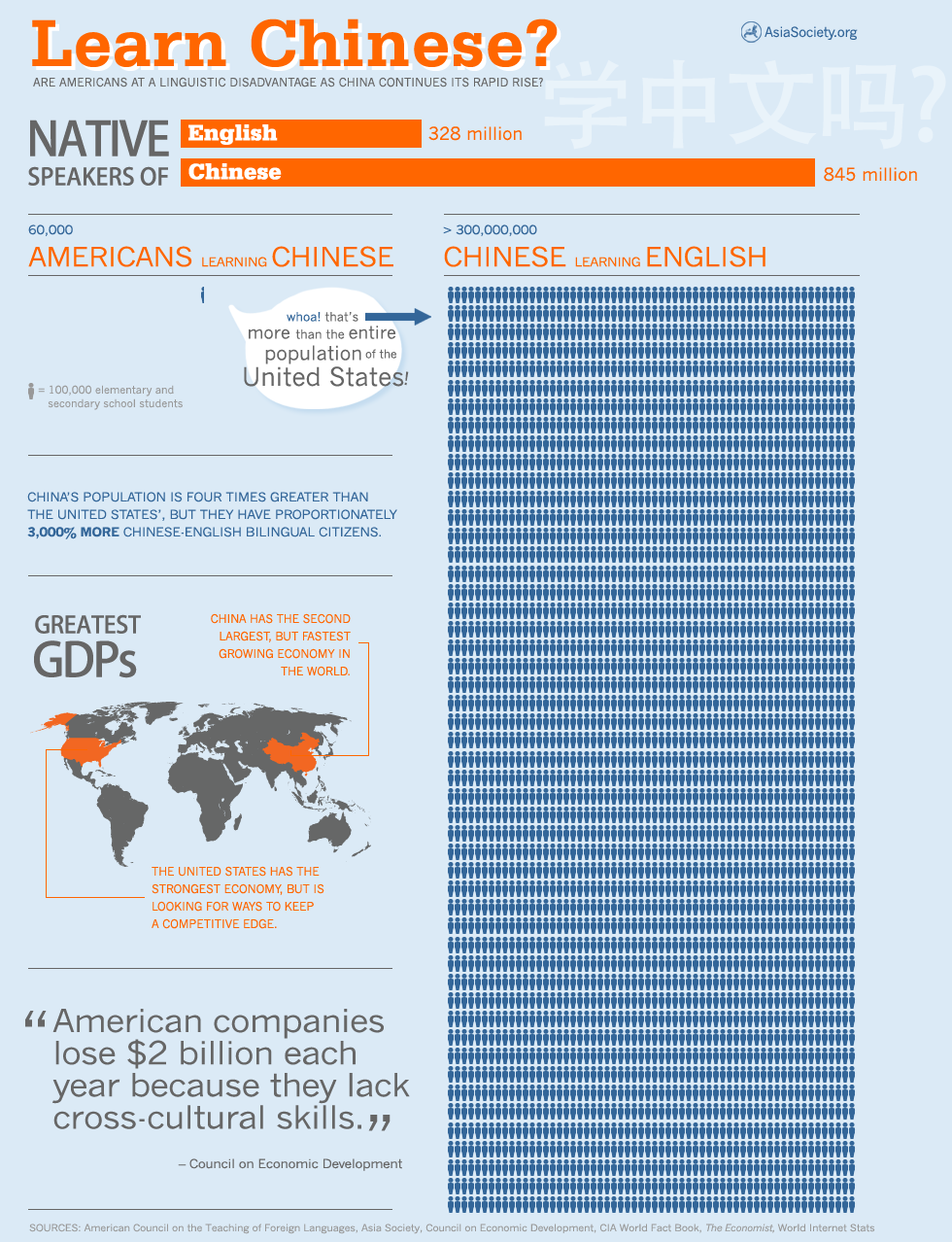
I love a good Language Infographic

A collection of Language Infographics. I like to read these, though some are inaccurate. I suppose if you get some statistics and present them in a colourful and attractive way it makes and interesting read. Though I think you can emphasise and highlight some things with a clever graphic representation. Still I enjoy reading them.


America Meet China


Some of these I have found and blogged before...others I found on Pinterest (a pictorial aggregator / semi social networking site), for compiling some of the Language Infographics.  You may find the other things on the board interesting too.  You might find a Chinese Mandarin Learner board there too. 

30 July 2012

8 Useful Phrases for American Retailers

This is very clever.  I found it originally posted on Magnus and Mingxin's board on Pinterest.


It is the creation of Dim Sum Warriors who write a bilingual app. The aim of the app is to help English and Mandarin learners in a way that is innovative, effective and fun. Looks like an excellent idea. 


Read a Comic, Learn a Language


16 June 2012

Why You Should Learn Chinese


Dreaming in Chinese: Mandarin Lessons in Life, Love, and Language

A two year old article from Time, yet it is still relevant today. The article is a question and answer interview about learning Mandarin and China.  It is worth reading.

  One book I will be adding to my reading list.

Q&A: Author Deborah Fallows on Learning Mandarin

Why study Chinese?

Why study Chinese?


07 May 2012

Why Languages Can Make Us Smarter, Safer, and Better Looking - Global Learning - Education Week


Some important issues are discussed in the Why Languages Can Make Us Smarter, Safer, and Better Looking  from Global Learning blog.

There are two basic arguments for second language learning;


One; learning a language is good for national security and economic competitiveness (this argument is a good one for politicians and business leaders)

"this can make our nation stronger"

Two; learning a language  is good for cognitive and cultural benefits (good for those in the arts and education business and parents)

"this can make my kid smarter"

Both arguments have received media attention in the USA. There seems to be much recent research about learning the language in the early years of school (the earlier the better). It is believed that starting language learning in middle school and high school is too late and not so beneficial. 

01 May 2012

Being bilingual 'boosts brain power'

Interesting news about a study about bilingual and monolingual brains.

Extracts from the articles include;
  • ...bilingualism is a form of brain training - a mental "work out" that fine-tunes the mind. 
  • ...against a backdrop of noisy chatter, the bilingual group were far superior at processing sounds. 
  • It seems that the benefits of bilingualism are particularly powerful and broad, and include attention, inhibition and encoding of sound. 
  • Past research has also suggested that being bilingual might help ward off dementia.
  • ...those who were fluent in two languages rather than just one were sharper mentally. 
  • being able to speak, listen, and think in two languages and of using two languages on a daily basis appears to sharpen people's abilities to pay close attention to aspects of tasks relevant to good performance.
  • It appears...that bilingualism helps to offset age-related losses.
Read more here
BBC News - Being bilingual 'boosts brain power'
BBC News - Research to find effects on brain of bilingualism
Being bilingual 'protects brain'


'via Blog this'
Blogger Widgets