Showing posts with label Fun. Show all posts

06 July 2012

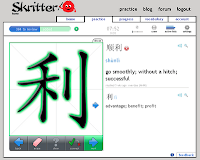
Skritter + Wacom Tablet = Faster Hanzi Learning

Just over a month ago I bought two new Chinese learning resources. These are a subscription to Skritter and a Wacom Touch Tablet.


   += Faster Hanzi Learning

Things I like about learning with Skritter:


  • Keeps me interested and motivated 
  • Allows me to track progress and time spent learning 
  • Makes learning Hanzi enjoyable 
  • Allows me to focus on words I need or want to learn 
  • Integrates with MDBG allows lookups and adding 
  • Allows me to add new words from websites with one click 
  • Helps me revise 
  • Gives a sense of satisfaction and achievement 
  • Has ready made sets of vocabulary for NPCR texts 
  • Can work on computer or iPad 
  • iPad App allows offline practice and syncs when connected Am able to use my Wacom tablet to write hanzi with a pen
  • Plus many more reasons to use Skritter
The Wacom tablet allows me to write hanzi with a tablet pen. I feel that this to be better than writing with a mouse. I can also use the tablet to write hanzi in Evernote, Windows journal, Photoshop and other programmes that use ‘Ink’ input.


The only disadvantage the tablet is quite sensitive and I feel it makes my hanzi 不好看Bù hǎokàn (unattractive) Looking at my sample tablet written hanzi below I think you will agree. 


我的汉字不好看。Wǒ de hànzì bù hǎokàn. 


Still it gives me satisfaction to be able to use technology to learn and practice hanzi.


I am interested to know how others are using Skritter. It is has many features and I am not sure that I have found them or use them all yet. I know that Skritter is a very popular hanzi learning tool. I wonder how many people are using it?


It would be good to know if anyone else is using a tablet to hand write hanzi on computers.


Does anyone use iPads for hand writing hanzi? I have not been able to find a satisfactory App to do this properly.

30 May 2012

I Do Whatever The Voices In My Head Tell Me To Do...

Learning a new skill? Talk to yourself about it

This interested me. Have heard that positive self talk is good for boosting confidence. Recent research shows that self talk may assist in in learning new skills.

"American magazine Time reports that instructional self-talk can enhance our attention, helps us regulate our effort and make decisions about what to do and how to do it..."

"Exercise Psychology finds that "self-talk" works best when you think about the goal for yourself and then make a mental plan for how to get there."

"While self-talking aloud may seem a bit crazy, it can also have benefits."
For my language learning I think I have been doing this for years...


Learning a new skill? Talk to yourself about it

07 October 2011

Chinese Picture Dictionary


Here is a great resource for visual learners. A Chinese Picture Dictionary. Lots of categories with the word in English, hanzi, pinyin and an audio to listen to for correct pronunciation. I found it very useful. There are 52 catagories from Airplane to Weather. Fast to load and quick and easy to look up. An excellent multimedia resource for learning Chinese.


The about page has this information

 “The Chinese Picture Dictionary is a multimedia courseware that aims to expand the vocabulary of beginning-level Chinese language students.  The Chinese Picture Dictionary presents several hundred pictures based on familiar settings of daily life. ..Each picture is presented in an individual page, along with buttons students can click to view the depicted vocabulary word written in Chinese script, view the pronunciation spelled out in Pinyin romanization, and  view a sample sentence using the word.  In addition, students can listen to native speakers of the language pronounce the word. 


The Chinese Picture Dictionary originated from the fact that pictures have long been favored by language teachers as a learning tool.  Because of their visual nature, they can say far more than words, and avoid the unnecessary use of translation.  The thematic presentation of 20 pictures together aims to help Chinese language students to streamline their learning and knowledge of new vocabulary in an effective way.”

02 September 2011

MDBG English Chinese Dictionary

MDBG English Chinese Dictionary is the best online dictionary I have found so far.  The dictionary The word dictionary contains information about Chinese words, consisting of one or more Chinese characters. Results of searches in the word dictionary will show the following;

  • Simplified / Traditional Chinese, the Chinese words matching the query
  • Mandarin, the Mandarin pronunciation in Pinyin or ㄅㄆㄇㄈ (Zhuyin Fuhao)
  • English, the English definition
  • Traditional / Simplified Variant, the Traditional / Simplified variant if available
  • HSK, the HSK level(s) in which this word occurs

I find it very useful as it has animated stroke order and you can hear the hanzi pronounced.   It will break the hanzi into character composition. The interface is very easy to use. So a very useful tool for a Chinese Mandarin Learner. Have a look for yourself MDBG Character Dictionary


22 August 2011

Why do Chinese often ‘adopt’ Western names?

Why do Chinese often ‘adopt’ Western names? It is a question that has always puzzled me. Many of the Chinese that I have met have a Western name, not all but many. Occasionally they have a name that surprises me such as “Minnie”, “Apple” or “Edna”…How did they come to choose such a name? I have searched on several forums on the Internet and have found no satisfactory answer. I found lots of speculation but no real answers. Does anyone have a good answer or explanation?


Just for fun if you want the transliteration of your name in Chinese here is a tool for you. Find this at Chinese-Tools.com. One more tool on the same site is a Chinese Calligraphy Editor where you new found hanzi name can be rendered into calligraphy font. 


Here is what the first tool came up with for my name:
 
Jonathan 乔纳森 (Qiáo nà sēn)


Here is the second tool came up with: 


 Now I really hope that these tools have given me an accurate transliteration of my name. I can only hope that my name has not been translated into the Chinese equivalent of “Rupert”, “Percival” or “Two dogs”. 

Just to check there is another blog that I often read.  A site called "Hanzi Matter" a site dedicated to the misuse of Chinese characters in western culture. "Hanzi Matter" has tattoos, signs, clothing and more with incorrect Chinese hanzi and Japanese Kanji.  So just to be safe I am going to have my new name in hanzi Jonathan 乔纳森  checked out before I have it tattooed across my body.


Blogger Widgets