30 September 2011

Satisfaction 满意


Today I finished my CHIN102 2nd assignment. I now have a very satisfied feeling of having completed something towards my studies and towards my degree. The assignment is finished ten days early as I was determined to get it done before the end of my two weeks holidays.


Other good news for me this week is that my flights have been arranged and booked for me. For the first three weeks of 2012 I will be in Xi'an, Shaanxi, PRC. It is part of my ALAP course of study at UNE. I will be studying at Shaanxi Normal University. It is quite exciting for me to go back to China again. Last time I was in mainland China was eleven years ago. It is excellent having this great opportunity to go to China to study. 我很满意。


28 September 2011

Memrise Flash Cards


I am trying a new flash card website called Memrise It is a free online flash card program / system. The first time I used it I didn't like it much...but returning to it I have found it useful. To make your own card set is not as easy as it could be, but I persevered and ended up getting useful set for NPCR lesson 16. There are many wordlists already created for HSK and multiple Chinese text books. I prefered to use my own as I much prefer my pinyin with tone marks instead of numbers.

The learning methodology behind Memrise is that it uses memory techniques to optimise learning. It uses spaced repetition system. As well as this it has an interesting interface with a garden metaphor. So you plant seeds in a green house, plants in a garden and water plants. It is expressing the the growth of you memories. The idea is to experience the flash cards in a dynamic environment. The Memrise Blog explains all this in some detail.

Something I haven't explored in detail yet is the Mem Stream a page where you can make mnemonics and have them rated by other language learners. There is also a Leaderboard which has your ranking out of all the users for the day, week, month and alltime. At present I am 4102nd....I was 6532nd yesterday.

So I am going to persist with Memrise for a while to see if it helps me learn my vocabulary. I will of course also contine to use Quizlet ( I really like the tests that can be generated) and Hanlexon to make hanzi practice sheets and lists.  


21 September 2011

Another Free Chinese Mandarin Learning Resource


Another Free Chinese Mandarin Learning Resource

I found another resource 好好学习天天向上 hǎoháo xuéxí tiāntiān xiàngshàng or the English title Day Day Up! - Chinese Free Online Chinese Mandarin Text book. I think it is a rather long winded title in Chinese and English. However, it is indeed free.

The methodology is that vocabulary and sentences are presented in small pieces or chunking the information. There is lots of repetition. The vocabulary is very practical. Most of the sentences are well explained with grammar notes. The site claims to have PDF downloads of each lesson but I could find none. There are MP3s in each of the lessons. It is not the easiest site find what you are looking for. 

The topics are;

  • Origins and Nationalities
  • Relationships and Modifiers
  • Coming and Going
  • Time
  • Study
  • Wants and Desires
  • Likes and Dislikes
  • Work

There is even some humour scattered throughout the text. “It presents authentic and practical language that is immediately useful – no more dialogues about Beijing opera”. I have to thank my friend / fellow Chinese Mandarin Learner, Christine, for finding that gem.  At the end of some sections you will find “The horrors of pronunciation.” and “You cheeky monkey!”, to name a few of the sections.

Alas it looks like this site was intended to also cover pre-intermediate to intermediate II levels, but these pages are blank. It is a pity as it makes a very good quick reference resource.

The site has a similar feeling to the 中文Red中文Green and 中文Blue pages that I reviewed earlier. Overall, I find 好好学习天天向上 a useful site that I find myself visiting occasional.  Day Day Up Chinese!

20 September 2011

NPCR1 to NPCR2


Recently I reached a milestone in my learning. I finished New Practical Chinese Reader and began New Practical Chinese Reader Two. There are some noticeable differences between the two texts. The most obvious is that there is no longer any pinyin with the dialogues that begin each lesson / chapter. The idea is that the text will gradually ween us off the use of pinyin. According to the introduction in NPCR1 this is part of the methodology of the series of books. A more subtle change is that the grammer, sentence patterns, questions and answers have become much more complex. I expected the texts to become more difficult, but there seems to be quite a jump from simple Chinese to more complex Chinese.

Here is something I did not expect. There are many suplementary resources for NPCR1 across the Net. As for NPCR2 there seems to be very few resources available. I can't understand this. It is as though learners had very good intentions to begin learning Mandarin, worked their way through NPCR1 and then stopped. Alternatively many of the supporting web sites seemed to have given up creating media that would help learners who choose this text. There are a few websites where I can still access some resources, but others finished with Lesson 14 of NPCR1. So this makes working through NPCR2 for me a bit more dull and less of a rich learning experience. I have searched for suplementary materials for NPCR2 and found nothing.

I still have access these sites;


Hanlexon

I should mention that my university UNE does supply me with multiple resources to support my learning. The lesson guides are very detailed, well written and support my studies. There is much to do and much to learn in my course of study. 

So onward and upward using NPCR2. If anyone has a NPCR2 related resource or resources I would be very pleased to know about it.  

14 September 2011

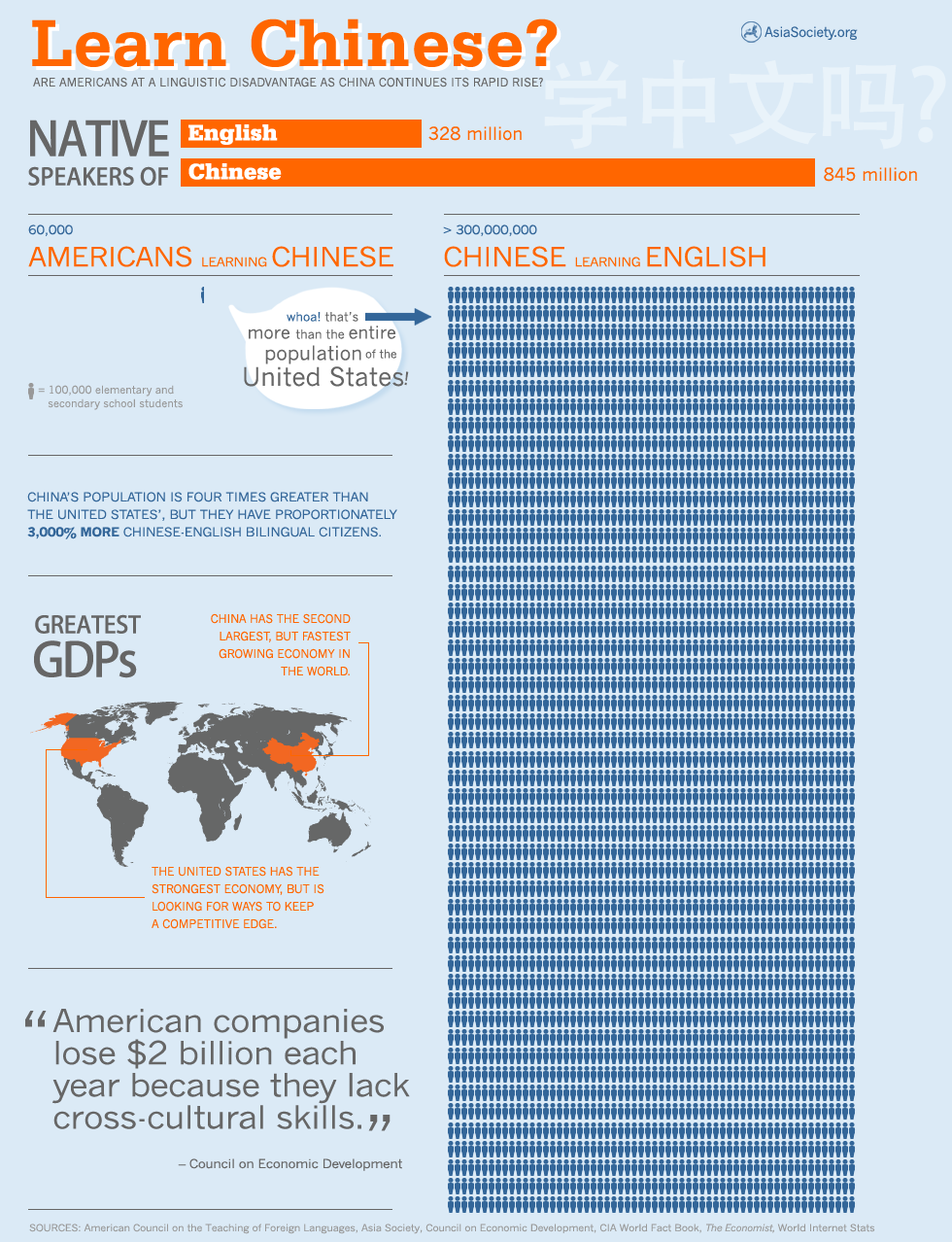
Learning Chinese? Infographic

Just found a very interesting Infographic from the Asia Society

Take a look Asia Society Infographic  

Here is another What are the Hardest Languages to Learn?

I am not sure if I am inspired or overwhelmed about the comment on the bottom left corner of the above infographic.

Lastly  China vs. America in Education America Meet China Interesting facts with huge numbers. The graphics do a great job to present the information, but the numbers are incredible.


What do you think? Your comments and feedback are very welcome.

11 September 2011

BBC Languages Chinese

The BBC website has an excellent and informative beginners Chinese language learning site. The pages would be very useful for beginners and travellers. The site contains two sections titled “An Introduction to Chinese” and “Chinese for beginners”. Within these sections you will find “A guide to Chinese – 10 Facts about the Chinese Language”, “Quick Fix – Essential Phrases”, “Real Chinese – Mini Guide” and similar pages. The site is very much like an on-line phrase book. There is a lot of attractive multimedia; pictures, animations and audio. If you are looking for a quick introduction to Chinese or need Chinese for your travels this is a good place to start. Have a look at BBC Languages Chinese.


BBC Languages Chinese

09 September 2011

Chinese Character Etymology


When learning characters I often find one of the best ways to remember is by learning the etymology of the hanzi. This method helps me a great deal. By looking at how the characters have changed over time and seeing their original forms creates links in my memory. I much prefer this to rote learning the hanzi.

I have found three sites that are useful to look up hanzi etymologies.

YellowBridge has a Etymology Explorer which allows you to draw the character (using a mouse) to aid lookup. There are other methods of lookup too; English, Pinyin and others. After finding the hanzi, the explorer can then show the formation method, simplification method and character decomposition.
Hanzi Etymology Explorer

 Another site Chinese-Characters.org has a Pinyin index and a Radical index. Unfortunately the last entry into the weblog was in 2009 and the home page explains that it was a huge project and a labour of love. Do not expect this site to have everything. 

Chinese-Characters.org

Third site that you can find much detailed information on hanzi etymology is 中文.com. While I like this site it does look very busy and complex. It displays the hazi with every associated compound. It does have multiple ways to lookup. You can even make quizzes with the learn page. 


So three very useful sites for etymology look-up. 

Does anyone know of any others? Leave a comment if you have a similar site to recommend.

07 September 2011

Make your own customised Hanzi Worksheets


I have been using Hanlexon Chinese to generate my custom hanzi practice sheets.  I like to do this when I need to focus on specific core vocabulary. Halexon will let you include stroke order and pinyin as a guide on the practice sheet. You can also make lists, print out flashcards, make online flashcards.  I find Hanlexon Chinese very useful for my hanzi writing practice.

03 September 2011

How do you say Bali (the tropical island in Indonesia) in Mandarin?


Here is something that came up during the weekend Intensive school I recently attended.  

How do you say Bali (the tropical island in Indonesia) in Mandarin?


This was important because bālí 巴黎 is how to write / say Paris (capital of France).


The answer is bālí dǎo 巴厘岛, Bali Island.


Most important when booking flights with Chinese travel agents. 


现在我喜欢旅行去巴厘岛。


再见 Jonathan

02 September 2011

MDBG English Chinese Dictionary

MDBG English Chinese Dictionary is the best online dictionary I have found so far.  The dictionary The word dictionary contains information about Chinese words, consisting of one or more Chinese characters. Results of searches in the word dictionary will show the following;

  • Simplified / Traditional Chinese, the Chinese words matching the query
  • Mandarin, the Mandarin pronunciation in Pinyin or ㄅㄆㄇㄈ (Zhuyin Fuhao)
  • English, the English definition
  • Traditional / Simplified Variant, the Traditional / Simplified variant if available
  • HSK, the HSK level(s) in which this word occurs

I find it very useful as it has animated stroke order and you can hear the hanzi pronounced.   It will break the hanzi into character composition. The interface is very easy to use. So a very useful tool for a Chinese Mandarin Learner. Have a look for yourself MDBG Character Dictionary


The most common Chinese characters in order of frequency

The most common Chinese characters in order of frequency is an interesting website. The 汉字 hanzi are listed according to falling statistical order.

The tip from the web page introductions states that the list could be used;

"Students can use the character list to create flashcards in order to train Chinese. Teachers can aslo make such cards to use in their teaching. Write the Chinese characters (possibly both simplified and traditional forms) on one side of a little piece of cardboard. Write pronunciation and explanations on the other side."

The list has 2700 hanzi. It has the first 2400 hanzi and then there are gaps. I like the look of this web site and the list. It has hanzi, pinyin and examples of usage and sentences. Quite a useful resources. Here is an from the beginning of the list.


The most Common Chinese Characters in order of Frequency


Blogger Widgets