Showing posts with label Online Mandarin Learning. Show all posts

11 August 2012

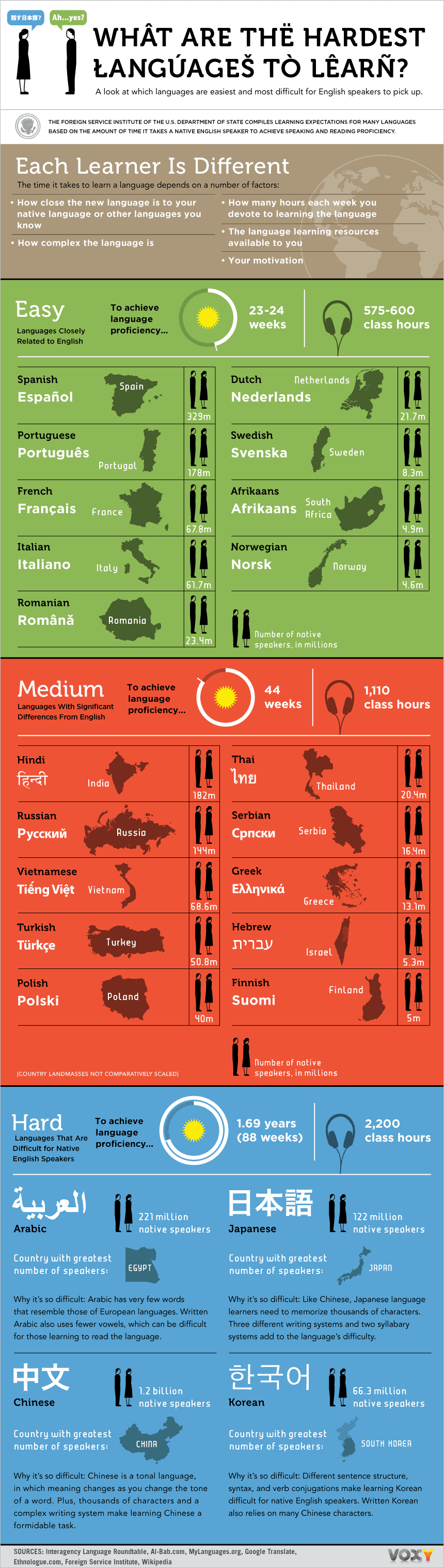
I love a good Language Infographic

A collection of Language Infographics. I like to read these, though some are inaccurate. I suppose if you get some statistics and present them in a colourful and attractive way it makes and interesting read. Though I think you can emphasise and highlight some things with a clever graphic representation. Still I enjoy reading them.


America Meet China


Some of these I have found and blogged before...others I found on Pinterest (a pictorial aggregator / semi social networking site), for compiling some of the Language Infographics.  You may find the other things on the board interesting too.  You might find a Chinese Mandarin Learner board there too. 

03 June 2012

Separable disyllabic verbs 离合词

Apparently some verbs can be split. These are Verb + Object structures.  In English some phrasal verbs can also be split. Some English phrasal verbs.

I looked up the number in the phone book.
I looked the number up in the phone book.

游泳 yóuyǒng ( to swim)
化妆 huàzhuāng (to put on make-up)
排队 páiduì (to line up)
过期 guòqí (to be overdue)
罚款 fákuǎn (to fine)
打的 dǎ di   (to take a taxi)
开车 kāichē, (to drive)
住院 zhùyuàn (to go to hospital)
看病 kànbìng (to see a doctor)
发烧 fāshāo (to have a fever)
上课 shàngkè (to begin class)
开学 kāixué (to start a new school term)
睡觉 shuìjiào (to sleep)
起床 qǐchuáng (to  get up)
吃饭 chīfàn (to eat)
聊天        liáotiān    (to chat)

from New Practical Chinese Reader: Textbook Vol.3  page 16-17.

我想在咖啡馆聊天。Wǒ xiǎng zài kāfēi guǎn liáotiān. I would like to chat in the coffee shop.

我想在咖啡馆聊一会儿天。Wǒ xiǎng zài kāfēi guǎn liáo yīhuǐer tiān.  I would like to chat for a little while in the coffee shop.


她说话。 Tā shuōhuà. She talked.
她说了很长时间的话。 Tā shuō le hěn cháng shíjiān de huà。She talked for a long time.


More examples from;

NPCR3
 
离合词 separable disyllabic verbs a copy from New Practical Chinese Reader: Textbook Vol.3  page 16-17.

Excellent explanations and examples on Chinese Grammar Wiki Separable verb and a very extensive list List of separable verbs

28 November 2011

10 Free Chinese Lessons


Grasp Chinese.com has to free multimedia lessons. Topics include;

  • Saying Hello
  • Introduction to tones
  • Ordering a Coffee
  • Airport -arriving
  • Taxi – going to the hotel
  • Hotel – checking in
  • Numbers
  • Breakfast
  • Shopping
  • Introducing yourself

Lesson include; Video, practice listening, writing words, writing sentences and a vocabulary list. Creating an account will track your progress and keep score of what you have done. All lessons are in Pinyin and English.

While all of these lessons are now too low level for me, I still think they are of a good quality. The attempt to create some interactive and basic lessons is quite good.


Not bad for free. Grasp Chinese

20 September 2011

NPCR1 to NPCR2


Recently I reached a milestone in my learning. I finished New Practical Chinese Reader and began New Practical Chinese Reader Two. There are some noticeable differences between the two texts. The most obvious is that there is no longer any pinyin with the dialogues that begin each lesson / chapter. The idea is that the text will gradually ween us off the use of pinyin. According to the introduction in NPCR1 this is part of the methodology of the series of books. A more subtle change is that the grammer, sentence patterns, questions and answers have become much more complex. I expected the texts to become more difficult, but there seems to be quite a jump from simple Chinese to more complex Chinese.

Here is something I did not expect. There are many suplementary resources for NPCR1 across the Net. As for NPCR2 there seems to be very few resources available. I can't understand this. It is as though learners had very good intentions to begin learning Mandarin, worked their way through NPCR1 and then stopped. Alternatively many of the supporting web sites seemed to have given up creating media that would help learners who choose this text. There are a few websites where I can still access some resources, but others finished with Lesson 14 of NPCR1. So this makes working through NPCR2 for me a bit more dull and less of a rich learning experience. I have searched for suplementary materials for NPCR2 and found nothing.

I still have access these sites;


Hanlexon

I should mention that my university UNE does supply me with multiple resources to support my learning. The lesson guides are very detailed, well written and support my studies. There is much to do and much to learn in my course of study. 

So onward and upward using NPCR2. If anyone has a NPCR2 related resource or resources I would be very pleased to know about it.  
21 August 2011

中文Red 中文Blue 中文Green


Recently I found these three excellent resources.  Three websites called Chinese language Red, Blue and Green. The three websites all have lessons in simplified hanzi, pinyin and English. There are PDFs to download and mp3s of native speakers.  Finding specific grammar points or words is sometimes a bit hit and miss, as there is not search. However, for the quantity and quality of the free lessons all three web sites are really useful for quick specifics for sentences and grammar. The web site states that it is a vocabulary-centered language learning.   Have a look at Chinese language Red, Blue and Green; 中文Red  中文Blue 中文Green

23 July 2011

Flash Cards Part II

My previous brief mention of Quizlet did not really do justice to all that can be done on the website.  This site makes flashcards fun.  Most of the activities are offered for free.  You can create a set of electronic double sided flashcards. I have created sets in various combinations; English / Pinyin, English / Hanzi, Hanzi / Pinyin, etcetera. The interface for making these is very simple and intuitive. You can drag and drop from lists and import complete sets from other applications such as Excel or Word. 

One of the best features of is that Quizlet will read the card to you. This is really important for aural learners.  More importantly it is an excellent tool for Mandarin learners as tones are so important. Quizlet doesn’t always read the tone correctly, but it is mostly accurate. 

Below the cards are a number of activities to where Quizlet will test you. These are Speller, Learn and Test.  I tend to use the Quizlet Test feature. It will generate a random test which can be customized with these features; Written, Matching, Multiple Choice and True/False questions. There are even more choices for customization of your test below this.  After taking the test it will automatically add up your score and give you a percentage and grade.  You can retake the test or generate a new one. More learning tools include two types of games Scatter and Space Race. I have tried these, but much prefer the Test feature. 

Finally Quizlet is cross platform. It works very well on my Windows PC and my iPod and iPad. So anywhere where there is a wireless connection I can access Quizlet. I think every serious learner should use Quizlet to learn Mandarin. 

Below is a set of NPRC Lesson 11 flashcards that I created, same set of cards in with the Learn activity and the Scatter game.  Try them and see what you think. 


Blogger Widgets